

Last updated on January 24th, 2026 at 01:31 pm
“Identifying and preserving architecture characteristics is a key responsibility for architects.” — Neal Ford
Quality attributes, also known as non-functional requirements, architecture concerns, or architecture characteristics, are foundational to good architecture. Performance, scalability, security, availability, maintainability, and usability often determine whether a system succeeds or fails.
Yet for many new architects, quality attributes are consistently underestimated. Not because they are unimportant, but because they are poorly understood.
Why Quality Attributes Matter
Quality attributes shape how a system is built, not just what it does. They influence architectural structure, technology choices, deployment strategies, and trade-offs long before a single line of code is written.
When architects clearly identify and document a system’s quality attributes, they can make informed decisions and explain why those decisions were made.
Consider a few common scenarios:
- In domains where regulations change frequently, isolating regulatory logic from more stable components becomes critical. This often leads to modular designs or service boundaries that minimize the blast radius of change.
- In systems with predictable traffic spikes, such as when thousands of users access the platform simultaneously, scalability becomes a top concern. This may justify architectural choices such as horizontal scaling and asynchronous communication.
- When a system integrates with external components that evolve or are replaced regularly, maintainability and modifiability should guide the design. Introducing abstraction layers can reduce coupling and protect the core system from external volatility.
In all these cases, architecture decisions are not driven by functional requirements alone, but by the quality attributes the system must preserve over time.
Requirements vs. Architecture Characteristics
Functional requirements describe what the system should do. Architecture characteristics define the essential qualities of the system:
How those requirements will be implemented, and
Why specific trade-offs were made?
Ignoring this distinction often leads to architectures that technically “work” but fail operationally, financially, or organizationally.
How to Identify Quality Attributes
Some quality attributes are explicit. You may find them directly in requirements or constraints:
- expected number of users
- response time targets
- availability or uptime expectations
However, many of the most impactful architecture characteristics are implicit. They emerge from business context, organizational structure, regulatory environments, and long-term evolution goals. Discovering them requires active collaboration with stakeholders, not just reading documentation.
This is one of the architect’s hardest responsibilities.
Document and Prioritize Early
Quality attributes should be documented incrementally from the very beginning of a project. Share them early with stakeholders to validate assumptions and refine priorities. Not all quality attributes are equal. Treating them as such often leads to generic architectures that fail to excel at anything. The architect’s role is to identify the driving quality attributes, the few that truly shape the system, and consciously design around them.
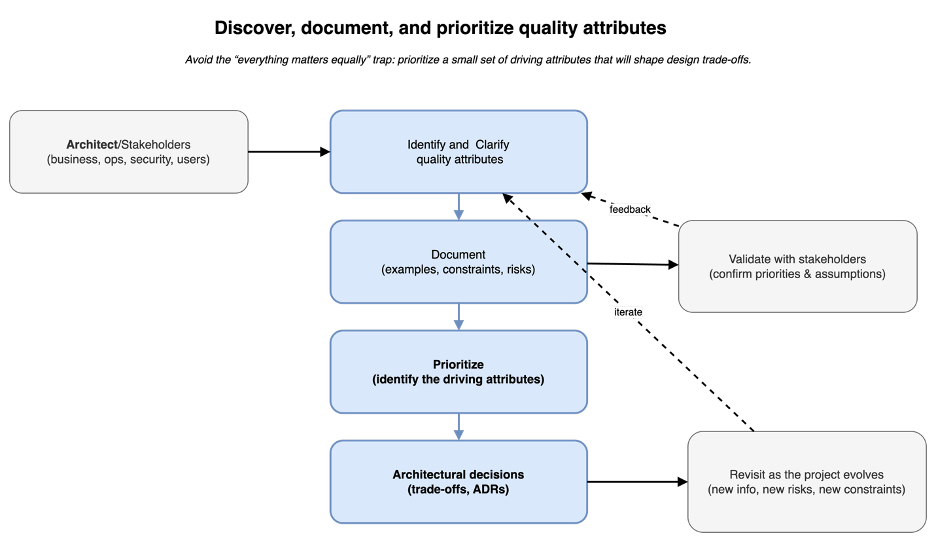
If there is one key takeaway, it is this: identifying and prioritizing quality attributes early is both critical and difficult, and it must be treated as a first-class architectural responsibility.